Search This Blog

Thursday, October 21, 2010

The Big Five

Andrea has kindly allowed me to steal this picture from her blog. (:
Equation number 3 is d = v1t + 1/2at2.
This can be derived from the graph. The first part of the equation is basically the area of the rectangle. The second part of the equation is basically the area of the triangle. Add them together and you get the area of the trapezoid. (:

Equation number 4 is d = v2t - 1/2at2
The first part of this equation is a big rectangle (b x h). The second part is the area of the triangle that isn't part of the graph. Subtract them and you get the area of the graph. (:

Wednesday, October 13, 2010

translating graphs

Original graphs (B)

(C)

(D)

(E)

(F)

(G)
And the graphs translated:


Friday, October 1, 2010

Motors (:

So in class today we made motors. That was pretty cool. We used things like wood, nails, corks, and a part of a pop can and it spun...or it was supposed to, anyway.

Ours worked on the second day, after making some slight changes.

We basically hammered nails into a wood base and tacked the brush onto the base as well. We stuck a kabob stick into a cork and stuck nails in it. Then we wrapped wire around it and hooked the whole thing up.

When the magnets were added (that's what the nails were for) and it was connected to the power source, it spun. (:

And there were sparks.

Photobucket
I thought this was relevant.

Wednesday, September 22, 2010

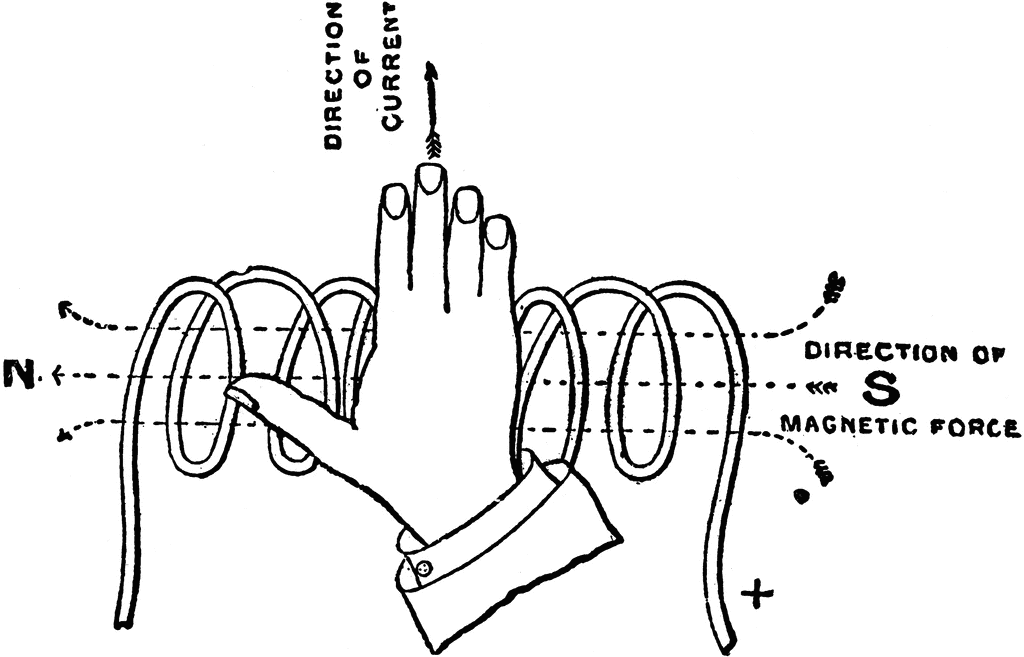
Right Hand Rules 1 and 2

Point your right thumb in the direction of the conventional current to use the rule
RHR 1. Basically when a conductor is conducting electricity, it creates a magnetic field around it. By applying the right-hand rule, you can figure out which way the magnetic lines are going.

The second RHR will help you figure out the direction of the north end of the temporary magnet when you have a conductor wrapped around a metal like iron. Your fingers represent the direction of the current (conventional current when using your right hand) and the direction your thumb is pointing is the direction the north pole of the magnet is. (:

Monday, September 20, 2010

10 points again

I'm sorry...I had to
  • Magnetic force = force that acts at a distance
  • magnetic field = distribution of magnetic force in a region
  • north and south poles on a magnet
  • north repels north, south repels south, north and south attract each other
  • test compass is used to map a field
  • earth is like a magnet
  • magnets also attract metals that are not magnets (iron, nickel and cobalt)
  • these are called ferromagnetic metals
  • right- and left-hand rules
  • ^ tbh I didn't quite get these rules

Tuesday, September 14, 2010

Moar Ten Points (pg. 553 - 563)

  • current flow is dependent on the voltage of the power supply and the 'nature of the pathway through the loads that are using electric potential energy'
  • the measure of the opposition to flow is called resistance
  •  R = V/I
    R
    is the resistance in ohms (Ω)
  • the V/I ratio is constant for a resistor
    the ratio is called "Ohm's law"
  • thinner wire has a larger resistance than thicker wire
  • resistance of a conductor depends on its length (the longer the wire, the greater the resistivity), cross-sectional area (the thicker the wire, the less resistant), the material it is made of (some materials are better conductors than others), and its temperature (greater heat = greater molecular motion = more particle impediment)
  • R1/R2 = L1/L2, R1/R2 = A2/A1, R1/R2 = ρ1/ρ2
    L = length, A = area,
    ρ = resistivity
  • series circuits connect loads in a single path
  • parallel circuits connect them parallel to each other
  • Kirchhoff's current law: the total amount of current that flows through a junction point is the same as the amount of current that flows out of it
  • Kirchhoff's voltage law: the total amount of potential decrease in a circuit loop is equal to the total amount of potential increase in that same loop
Cheers

Saturday, September 11, 2010

Energy Balls

On Friday we had an activity with energy balls, which are balls like light up when used correctly.


1) Can you make the energy ball work? What do you think makes the ball flash and hum?
Yes. Closing the circuit (by touching the two metal pieces) makes the ball light up.

2) Why do you have to touch both metal contacts to make the ball work?
Touching both metal contacts closes the circuit. If you only touch one, the electrons cannot move through the entire circuit, meaning it can't light up the light.

3) Will the ball light up if you connect the contacts with any material?
No, it wont. The material has to be a conductor or else it will not allow the electrons to flow through it.

4) Which materials will make the metal ball work?
Metal, mostly. Also, salt water and human flesh, of course. (:

5) This ball does not work on certain individuals--what could cause this to happen?
Probably the most likely reason is if they're severely dehydrated. If someone's skin is very dry, it would not allow the electrons to flow through very easily, thus not completing the circuit and not causing the ball to light up.

6) Can you make the energy ball work with all 5-6 individuals? Will it work with the entire class?
Yes. (: It will work with 5 people and with the entire class.

7) What kind of circuit can you form with one energy ball?
A simple circuit. There is the battery, and light, and a conductor.

8) Given 2 balls, can you create a circuit where both balls light up?
Yes you can by creating a series circuit.

9) What do you think will happen if one person lets go of the other person's hand and why?
Both balls will stop lighting up because the circuit has been opened.

10) Does it matter who lets go? Try it.
 No, it doesn't matter who lets go. Anyone who lets go will act as a open switch in a circuit and the ball(s) will not light up.

11) Can you create a circuit where only one ball lights up (both balls must me included in the circuit)?
Yes you can. This type of circuit is called a parallel circuit. (:

12) What is the minimum number of people required to complete this?
You can actually do it with one person, but the balls would have to be held somewhat awkwardly. It does work, though.